
International Law and Cold War Dynamics
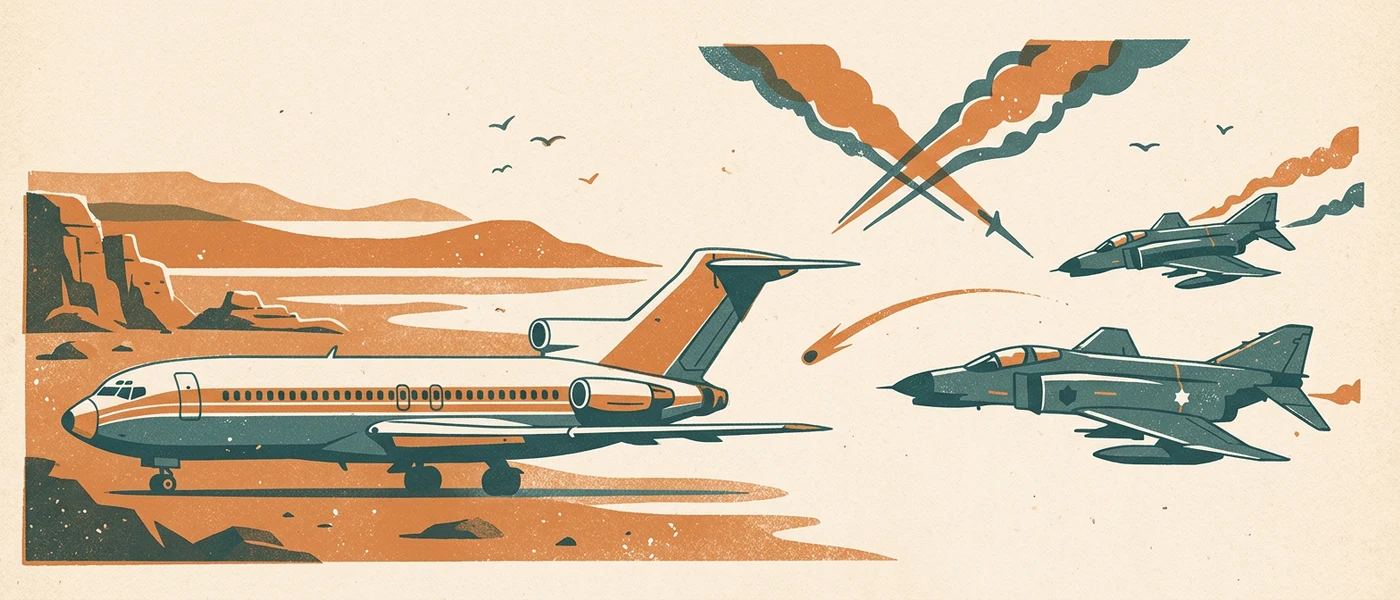
On February 21, 1973, Israeli fighter jets shot down Libyan Airlines Flight 114 as it flew over the Sinai Peninsula. Of the 113 people aboard, 108 died and five survived. Israeli commanders treated the plane as a possible military threat, but it was a civilian airliner carrying families, business travelers, and children. This collision between two forces—Cold War power plays and the fragile rules meant to protect ordinary people—reveals everything about how international law worked (or failed) in the Middle East during the 1970s.
International airspace law says civilian aircraft get special protection. They cannot be shot at. Period. The rules exist because civil aviation carries innocent people, not weapons. But the Arab-Israeli conflict wasn't about rules—it was about survival, territory, and the superpowers backing each side. The Soviet Union armed Egypt and Syria; the United States backed Israel. When the Yom Kippur War erupted in October 1973, eight months after the shootdown, tensions exploded across the region.
Here's the hard part: Israel claimed self-defense. The plane had strayed into airspace over Israeli-occupied Sinai. No war was being fought that day, but Israel and Egypt were still enemies. International law says nations can protect themselves, but it also says they cannot harm civilians. These two rules collided head-on. No court punished Israel. Israel offered compensation as a voluntary, humanitarian gesture rather than an admission of legal liability: $30,000 for the family of each person killed. By July 1973 it said it had paid out $300,000. The International Civil Aviation Organization (ICAO), the UN's aviation agency, condemned Israel by 105 votes to 1. The United States, Israel's main backer, offered sympathy to the victims' families and tried to soften ICAO's condemnation before reluctantly voting for it. The response stayed political: a condemnation and a voluntary payment, but no legal ruling. The crash shows that laws protecting civil aviation only work when all sides agree to follow them—and during proxy wars, that agreement vanishes.
When superpowers compete for influence, international law becomes a suggestion, not a command. Understanding this gap between what the rules say and what actually happens on the ground is the key to understanding modern conflict.
