
Battle of Stalingrad: Core Essentials
Covers Operation Barbarossa and the Eastern Front, Why Stalingrad Was Strategically Vital, Urban Warfare and House-to-House Fighting and more.
“Battle of Stalingrad: Core Essentials” is a 4-lesson course at Teen level, created with soclever, a personal AI teacher. Each lesson takes a few minutes and ends with a check-in question; finish the curriculum and you can take a certificate test to earn a diploma. Try the first lesson without an account — or make your own course on any topic. Shared by @meirrosenschein.
What you'll learn
- Operation Barbarossa and the Eastern Front. German tanks are rolling across the Ukrainian steppe in the summer of 1941, crushing Soviet defenses in their path.
- Why Stalingrad Was Strategically Vital. A Soviet soldier could stand on one bank of the Volga River and see German tanks on the other—yet neither side could leave.
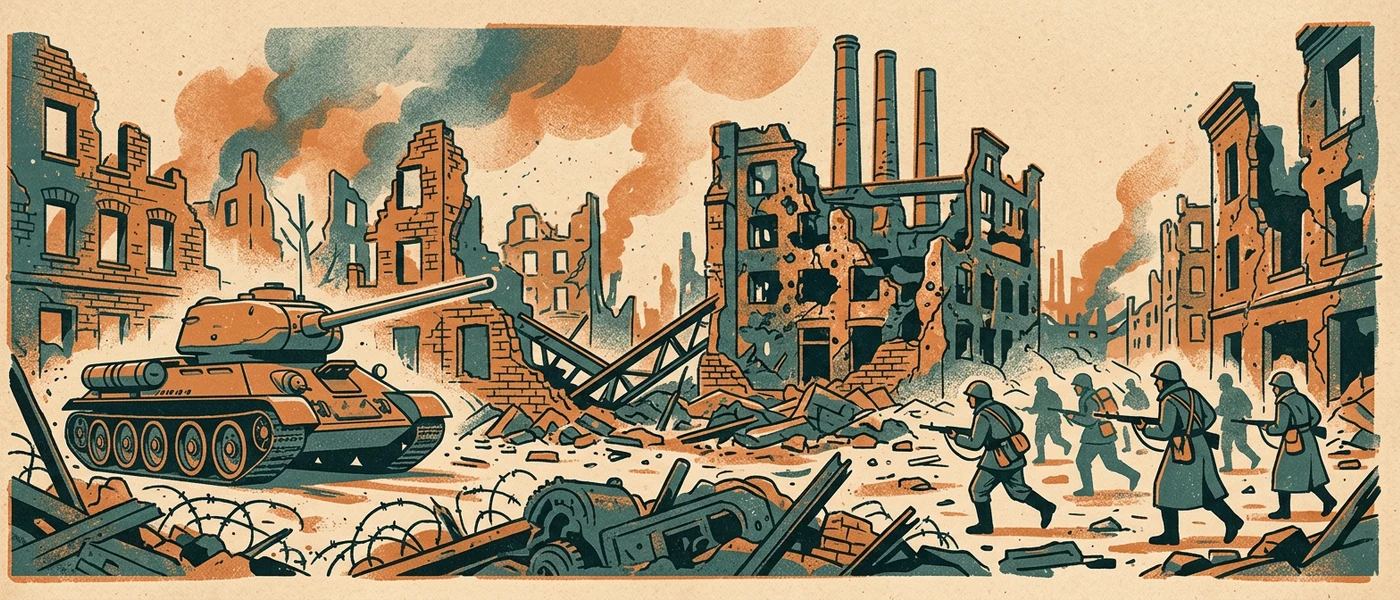
- Urban Warfare and House-to-House Fighting. At the height of the Battle of Stalingrad, in the autumn of 1942, soldiers fought across rubble separated by distances you could throw a stone—sometimes just 20 or 30 meters between German and Soviet lines.
- Soviet Production and Logistical Mobilization. In 1942, the Soviet Union built more than 24,000 armored fighting vehicles—while fighting on its own soil. Germany, the military powerhouse of Europe, built about 6,000.
Lesson 1: Operation Barbarossa and the Eastern Front
German tanks are rolling across the Ukrainian steppe in the summer of 1941, crushing Soviet defenses in their path. Millions of soldiers clash across a front that stretches over a thousand miles. This is Operation Barbarossa—and it's the moment everything changes. But why would Hitler risk invading his former ally? And what does this have to do with a city called Stalingrad?
Hitler believed the Soviet Union held the resources Germany needed: oil, grain, and living space for German settlers. He also saw Communism as an existential threat to his vision of Europe. So on June 22, 1941, he launched Operation Barbarossa, the code name for Germany's invasion of the Soviet Union—the largest military invasion in history. The Eastern Front, as it came to be called, was the main theater where Germany would fight the Soviets.
At first, German forces advanced rapidly. But the Soviet Union was vast, and by December 1941 the German drive had stalled at the gates of Moscow. So in June 1942 Hitler launched a new summer offensive in the south, aimed at Soviet resources and the oil fields of the Caucasus. Stalingrad—a major industrial city on the Volga River—now became a target. Capturing it would cut Soviet transport links with southern Russia and anchor the flank of the drive toward the oil. The city also bore Stalin's name, which made it a propaganda prize.
The invasion of the Soviet Union was driven by Hitler's hunger for resources and his hatred of Communism, and Stalingrad became the crucial battle where that strategy would be tested to its breaking point.
Questions this course answers
What was Operation Barbarossa?
Operation Barbarossa is the code name for Germany's invasion of the Soviet Union, launched on June 22, 1941, and it is the largest military invasion in history.
What resources did Hitler believe the Soviet Union held?
Hitler believed the Soviet Union held the resources Germany needed, which included oil, grain, and living space for German settlers.
Why did Stalingrad become a German target?
Stalingrad became a target of Germany's summer offensive of 1942. Capturing it would cut Soviet transport links with southern Russia and anchor the flank of the drive toward the Caucasus oil fields.
How did house-to-house fighting affect the battle in Stalingrad?
House-to-house fighting meant soldiers advanced street by street and building by building, turning the city into a grinding, brutal attrition where both sides paid a terrible price for every meter of ground.
More courses to explore
- Battle of Puebla — 3 lessons (Teen level).
- Claude Code Mods Essentials — 4 lessons (Teen level).
- Darija Essentials: Moroccan Arabic Basics — 4 lessons (Teen level).
- Handling Toddler Bedtime Resistance — 4 lessons (Teen level).