
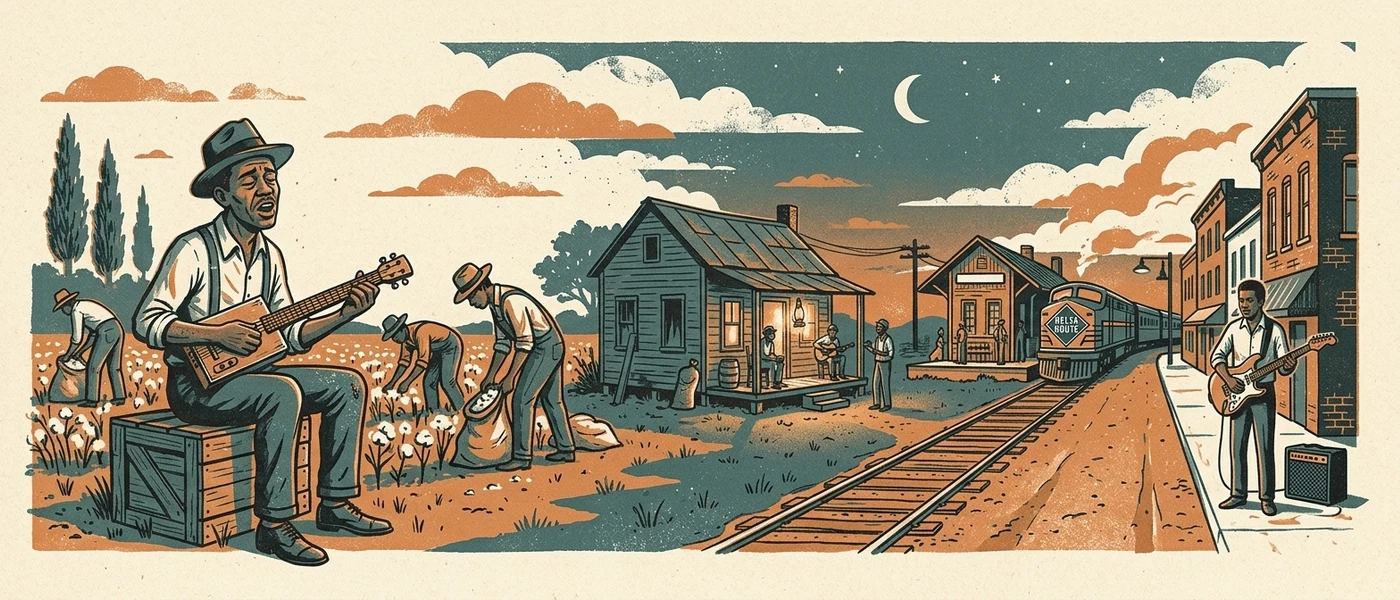
Blues as American Synthesis
Think of a pot of gumbo: the cook uses ingredients that came from different places, and the finished dish tastes like none of them alone. The blues works much the same way. It is a style of music that grew in the American South, around the late 1800s and early 1900s, among African American communities, and it blended several musical traditions into something new.
Let’s start with the African influences. Many enslaved people brought song traditions from West and Central Africa, including call and response, where one voice sings a line and another answers. Work songs and field hollers, which were loud, solo calls sung while laboring outdoors, carried these habits forward. Also important were bent or sliding notes, where a singer glides between pitches instead of landing neatly on one.
Next come the European and American ingredients. European music supplied instruments such as the guitar, along with familiar chord patterns, which are groups of notes played together to support a melody. Hymns and folk songs also shaped the sound. The American part was the setting itself: life after slavery, hardship, travel, and new ways of telling personal stories in song.
Where the ingredients came from
Shaped how the music was sung and shared.
Call and response
Field hollers
Bent notes
A common misconception is that the blues is purely African music carried over unchanged. In truth, it took shape in America, and it needed both African-derived ways of singing and European-derived instruments and harmony. It is also not a single invention by one person; it developed gradually in many places.
This synthesis, meaning a blending of separate parts into a new whole, helps explain the blues’ later reach. Jazz, rhythm and blues, and rock and roll all grew from it, so its influence is wide. That does not mean every modern song is blues, only that many styles borrowed its sound and feeling.
So the blues is gumbo in musical form: African singing habits, European instruments and harmony, and American experience simmered together. Nice work following along. Seeing it as a blend makes it easier to hear its traces in so much music today.
