
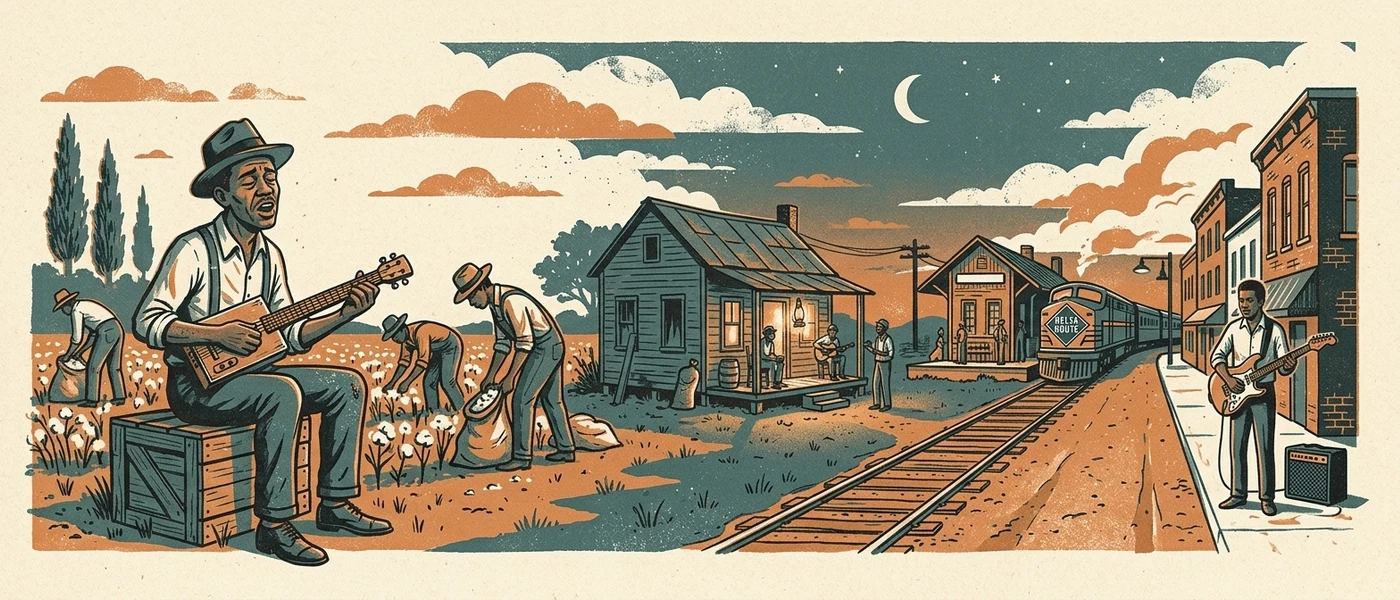
African Roots and Slavery
Slavery forced millions of Africans to America, tearing them from their homes and cultures. Yet enslaved people held onto their musical traditions—the rhythms, call-and-response patterns, and emotional depth of African music. At the same time, as many came to Christianity, they heard its hymns and created songs of their own, spirituals, that retold Bible stories and expressed sorrow and hope in a new language. Work songs emerged too, rhythmic chants that synchronized labor in the fields and made unbearable work bearable by giving it a pulse and a voice.
Think of it like this: an enslaved person in the American South around 1800 might sing a work song in the morning—a call-and-response about the cotton they were picking, with the rhythm of African drumming built into it. By evening, in a church or cabin, the same person might sing a spiritual about freedom and heaven, borrowing the melody and emotion of European hymns but filling it with African musical DNA: bent notes, blue notes (notes sung slightly lower than standard pitch to express sadness or pain), and a call-and-response structure that came straight from Africa. Over decades, these three streams—African rhythms and call-and-response, Christian spirituals with their emotional depth, and work songs with their insistent pulse—began to blend together in the lived experience of enslaved and then freed Black people, especially in the Deep South. That blend became the foundation of the blues.
The blues didn't appear overnight. It grew from the collision of these three traditions, each carrying its own truth about survival, pain, and resilience. Understanding where the blues came from means seeing it not as a single invention but as the living product of a people who refused to let their culture disappear, even under the cruelest conditions.
