
Sykes Picot Agreement Explained
A learner invited you
Covers What Was Sykes-Picot?, The Levant Border: Syria and Lebanon, Mesopotamia Divided: The Iraq Question and more.
“Sykes Picot Agreement Explained” is a 4-lesson course at Teen level, created with soclever, a personal AI teacher. Each lesson takes a few minutes and ends with a check-in question; finish the curriculum and you can take a certificate test to earn a diploma. Try the first lesson without an account — or make your own course on any topic.
What you'll learn
- What Was Sykes-Picot?. World War I was gutting the Ottoman Empire—the Turkish state that had ruled the Middle East for centuries. Britain and France smelled opportunity.
- The Levant Border: Syria and Lebanon. In 1916, two diplomats—Mark Sykes for Britain and François Picot for France—sat down to divide the Ottoman Empire's Arab territories without asking the people who lived there.
- Mesopotamia Divided: The Iraq Question. Most people think Iraq has always been a single nation with a shared identity. That's wrong.
- Palestine, Israel, and Unfinished Lines. Most people think the Sykes-Picot Agreement was a peace treaty. It wasn't.
Lesson 1: What Was Sykes-Picot?
World War I was gutting the Ottoman Empire—the Turkish state that had ruled the Middle East for centuries. Britain and France smelled opportunity. They wanted to carve up Ottoman territory after the war and claim it as colonies, but they couldn't just grab whatever they wanted. They needed to agree on who got what, so they couldn't end up fighting each other over the same land.
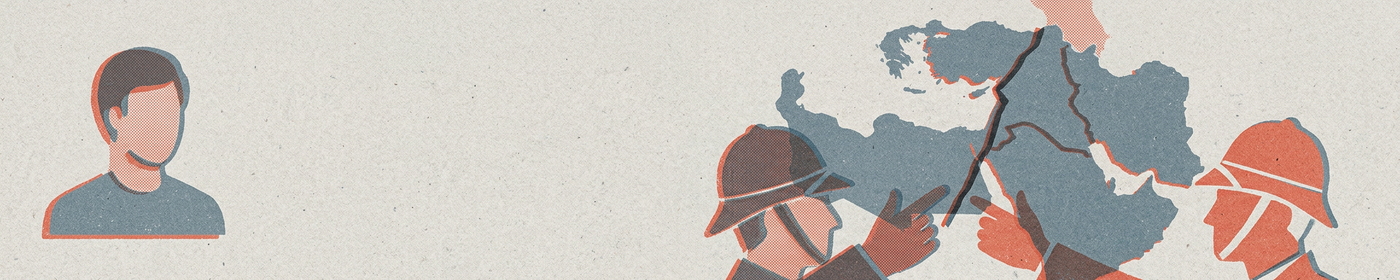
Enter Mark Sykes, a British diplomat, and François Georges-Picot, a French official. In 1916, they met in secret and drew lines on a map. Those lines became the Sykes-Picot Agreement—a deal that split the Ottoman Middle East into British and French spheres of influence. Britain took Iraq and Palestine. France got Syria and Lebanon. The lines were drawn with almost no thought to the people actually living there: Arabs, Kurds, Armenians, and dozens of other groups who had their own histories, languages, and loyalties.
The problem: these borders chopped up communities and bundled together people who had no reason to be one country. A line drawn in London or Paris didn't match the ground. Decades later, when the Ottoman Empire finally collapsed and these territories became independent nations, those arbitrary borders remained. They still do. Many of the conflicts tearing through the Middle East today—sectarian violence, disputed territories, ethnic tensions—trace back to borders that were never meant to reflect who actually lived there.
Sykes-Picot wasn't a peace treaty. It was two colonial powers dividing spoils, and the lines they drew shaped an entire region's future.
Questions this course answers
What was the Sykes-Picot Agreement?
It was a deal that split the Ottoman Middle East into British and French spheres of influence.
How did Britain and France divide the territories?
Britain took Iraq and Palestine, while France got Syria and Lebanon.
What was the Ottoman Empire?
It was the Turkish state that had ruled the Middle East for centuries and was being gutted by World War I.
More courses to explore
- Sykes-Picot Agreement — 4 lessons (Teen level).
- Science of Sleep Explained — 4 lessons (Teen level).
- Age of Exploration Explained — 4 lessons (Teen level).
- History of Iran Explained — 4 lessons (Teen level).