
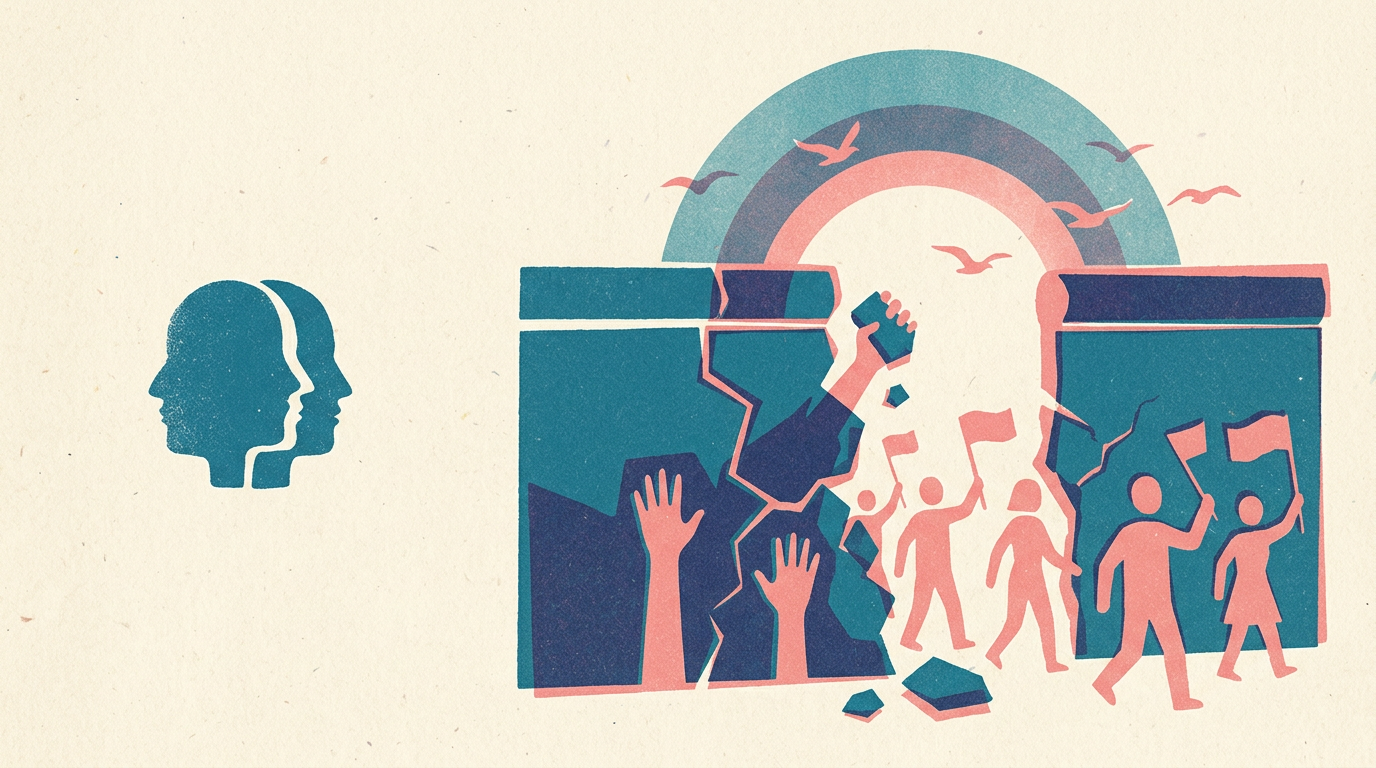
Fall of Berlin Wall
A learner invited you
Covers Cold War and Germany's Division, Why the Berlin Wall Was Built, Gorbachev's Reforms and Soviet Collapse and more.
“Fall of Berlin Wall” is a 4-lesson course at Teen level, created with soclever, a personal AI teacher. Each lesson takes a few minutes and ends with a check-in question; finish the curriculum and you can take a certificate test to earn a diploma. Try the first lesson without an account — or make your own course on any topic.
What you'll learn
- Cold War and Germany's Division. After World War II ended in 1945, Germany lay in ruins.
- Why the Berlin Wall Was Built. The Berlin Wall was built by East Germany in 1961 to stop its own citizens from leaving and to protect a failing economy — think of it as a fence around a sinking ship to keep the crew from jumping overboard.
- Gorbachev's Reforms and Soviet Collapse. Think of a strict household where the parents have always enforced the rules with a firm hand.
- Europe's Realignment After the Wall. Think of Europe in 1989 as a house split by a locked internal door, with one family on each side. When that door swung open, the rooms on both sides had to be rearranged.
Lesson 1: Cold War and Germany's Division
After World War II ended in 1945, Germany lay in ruins. The Soviet Union, the United States, Britain, and France had all fought against Nazi Germany together, but they didn't trust each other. Instead of letting Germany stay whole, the four winning powers divided it into four occupation zones—think of it like four neighbors agreeing to split a damaged house into four separate rooms, each one controlling their own space. The Soviets got the eastern zone, the Americans, British, and French each got sections of the west.
The problem was that these four powers had completely opposite ideas about how to run their zones. The Soviet Union, led by Stalin, wanted to spread communism—a system where the government controls almost all property and business, and citizens have very little personal freedom. The Western powers believed in capitalism and democracy, where people own businesses and vote on their leaders. It wasn't long before each side started reshaping their zone to match their own system.
By 1949, the split hardened into something permanent. The three Western zones merged into one country called West Germany, which was democratic and tied to the West. The Soviet zone became East Germany, officially communist and controlled by Moscow. Berlin, the capital city, sat right in the middle of the Soviet zone—but it too had been divided into four sectors, with the Western powers holding the western half. That's why the Berlin Wall, which you learned about earlier, would eventually go up: it was meant to seal off the communist eastern side from the democratic western side.
This division didn't happen by accident. It came from a fundamental clash: two superpowers with opposite beliefs about freedom and power, each trying to protect their interests and spread their system. Germany paid the price by being split in two.
Questions this course answers
- Why did Germany end up divided into four zones instead of staying as one country after World War II?
- Why did East Germany decide to build the wall in 1961 instead of letting people move freely between east and west?
- How did Gorbachev's decision not to use Soviet force to prop up allied governments help make the fall of the Berlin Wall possible in 1989?
- What are the main ideas behind Europe's Realignment After the Wall?
More courses to explore
- Why Did the Berlin Wall Fall — 4 lessons (Teen level).
- The Berlin Wall — 4 lessons (Postgrad level).
- Fall of Rome — 4 lessons (Teen level).
- This weeks parsha- Judaism — 6 lessons (Teen level).